Christian Gonzenbach @ Bex & Arts
Christian Gonzenbach is part of the exhibition Génies du lieu at the Bex & Arts triennial.
For its 16th edition, the Triennale honors the landscape, placing the site and the spirit that animates it at the heart of the exhibition. By inviting contemporary art to engage in a dialogue with the Genius Loci (Spirit of Place)”—those forces that connect a site to its history, memory, and myths—Bex Arts 26 explores the temporal depth of the park, which has become a true protagonist.
From May 30 to October 3, Szilassy Park opens itself to new interpretations of the world and transforms into a space for collective experimentation. Here, the tension between imagined and transformed nature, between contemplation and social reality, is replayed at the intersection of contemporary art, the living world, and landscape architecture.
30.05 - 03.10.2026
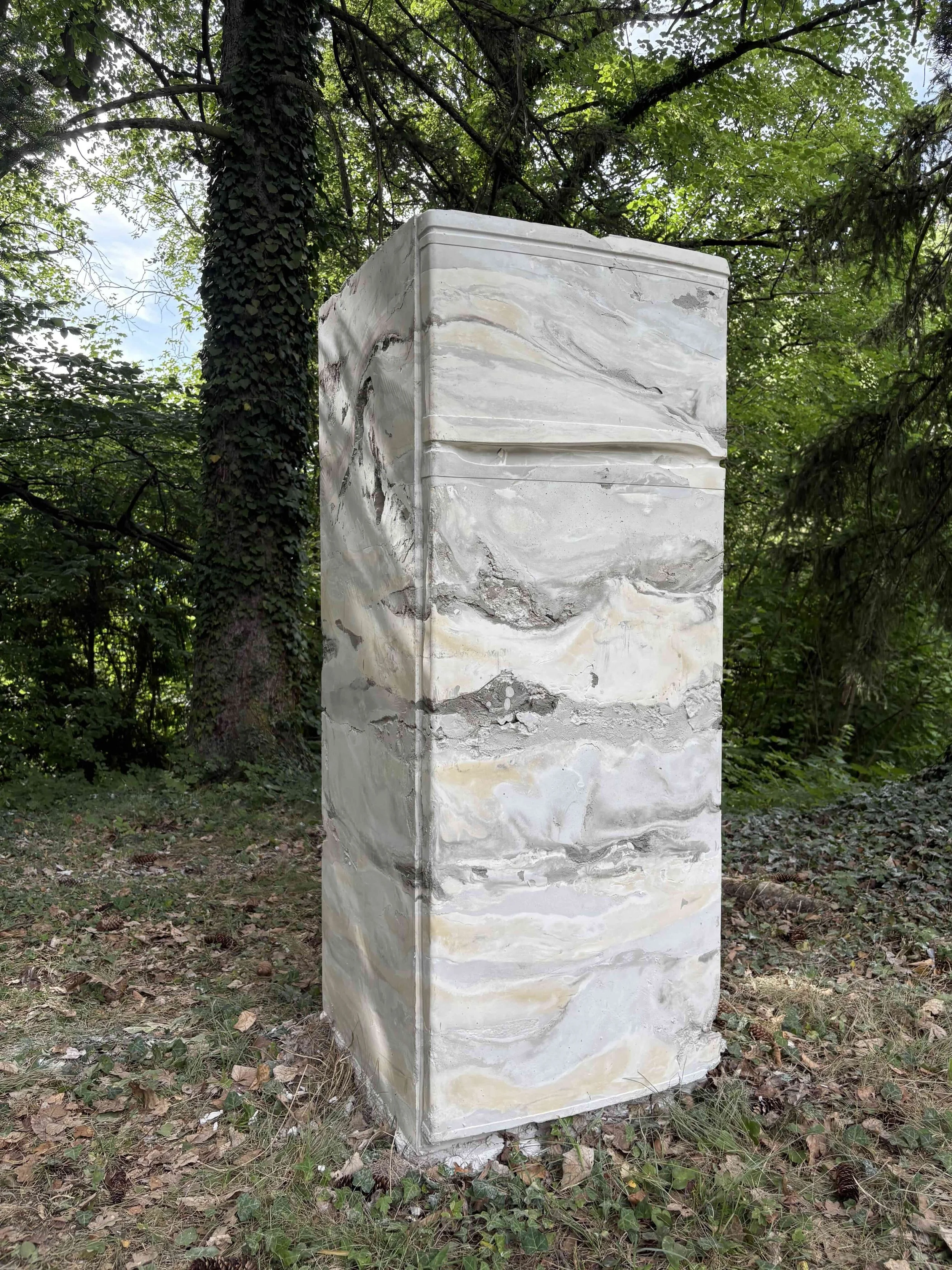
TIXIF, Les fossiles nous attendront, plaster and gypsum, 2026
Refrigerators appear across the park, looking strangely out of place and prompting us to wonder whether they are illegally dumped appliances or minimalist sculptures. But our focus shifts as the exhibition progresses. Because these fridges are, in fact, cast in plaster. Exposed to the elements, they slowly disintegrate, shedding their industrial appearance and taking on forms more akin to natural stone. And as the material breaks down, unexpected contents are revealed: hairdryers, carburettors, superhero figurines and statues of saints.
For Christian Gonzenbach, these objects serve as fossils of a modern, globalised, consumer society underpinned by mass production. By situating them within Szilassy Park – an English-style landscape garden designed to look effortlessly natural – the artist blurs the line between nature and culture and draws attention to the ways we produce, consume and dispose of objects.
Gonzenbach’s work sits firmly within wider artistic and cultural debates around the notion of the Anthropocene, a geological epoch in our planet’s history in which human activity has become a force of environmental change. That human imprint is felt particularly acutely in Bex, which is home to a gypsum quarry. The gypsum extracted there is used primarily to produce plaster and concrete, now the most widely consumed material on the planet and one that has shaped our built environment.